

What Is Collagen Supplement ODM?
Collagen supplement ODM refers to an original design manufacturing model in which a manufacturer does more than simply produce a finished supplement. The ODM partner may help with concept development, formula selection, ingredient sourcing, flavor adjustment, dosage form development, packaging coordination, product testing, and production planning. For brands that do not have an in-house formulation team, this model can shorten the path from product idea to commercial launch.
A collagen supplement ODM project can begin with something as simple as a target audience and positioning concept. For example, a brand may want to develop a collagen powder for beauty consumers, a ready-to-drink collagen beverage for convenience-focused users, or a collagen tablet combined with selected vitamins. The ODM manufacturer can then propose an existing base formula, a modified formula, or a more customized development path depending on budget, minimum order quantity, target market, and regulatory requirements.
This differs from a basic contract manufacturing relationship because the supplier is involved earlier in the product development cycle. A capable collagen supplement ODM partner may provide technical input regarding collagen source, molecular weight range, supporting ingredients, taste profile, solubility, serving size, packaging compatibility, and production feasibility. That broader service scope is one reason ODM is frequently considered by startup brands, distributors, e-commerce sellers, clinics, wellness businesses, and companies entering the supplement market for the first time.
Collagen Supplement ODM vs OEM Comparison
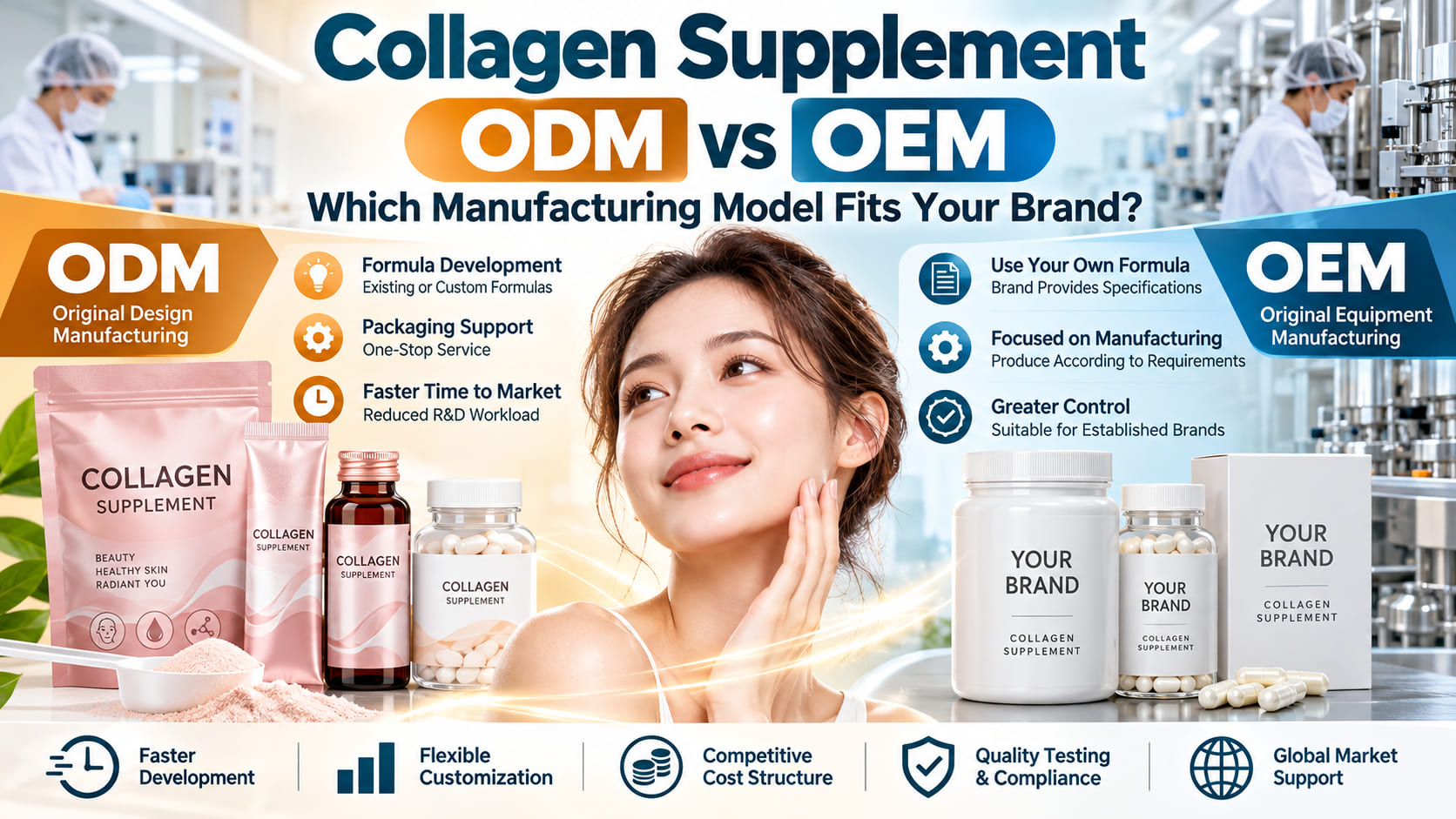
The most useful comparison is not whether ODM or OEM is universally better. The real question is how much product development responsibility your brand wants the manufacturer to handle. If you already own a detailed formula and understand your required specifications, OEM may be sufficient. If you need technical support and want to reduce development complexity, collagen supplement ODM may be the more practical route.
| Item | Collagen Supplement ODM | Collagen Supplement OEM | Best For |
|---|---|---|---|
| Formula development | Manufacturer may provide existing or modified formulas | Brand usually provides its own specifications | ODM for brands without in-house R&D |
| Development speed | Often faster when using a validated base formula | Depends on formula readiness and validation | ODM for faster commercialization |
| Customization | Ranges from light modification to custom development | Usually based on client-provided requirements | Depends on desired control level |
| R&D workload | Lower for the brand | Higher for the brand | ODM for lean internal teams |
| Initial investment | Can be efficient when using standard development options | May involve separate R&D expenses before manufacturing | ODM for simpler budgeting |
| Formula ownership | Must be clarified in the contract | Brand may retain greater control when providing its own formula | OEM for brands prioritizing proprietary formulas |
| Packaging support | Often available as part of a turnkey service | May be more limited depending on supplier scope | ODM for one-stop sourcing |
| Best business stage | Startup, market test, line extension | Established brand with clear specifications | Choose based on internal capability |
For a new brand, collagen supplement ODM can reduce the number of external vendors that must be coordinated. Instead of separately hiring a formulator, raw material supplier, flavor house, contract manufacturer, testing laboratory, and packaging supplier, the brand may be able to manage most of these activities through one manufacturing partner. This can simplify communication and reduce development bottlenecks.
How the Collagen Supplement ODM Development Process Works
1. Product Positioning and Target Market
The project usually begins with commercial goals. The manufacturer needs to understand the target consumer, preferred dosage form, target price, target market, expected claims, desired flavor, and distribution channel. A collagen supplement sold through premium beauty clinics may require a different positioning strategy from one designed for mass e-commerce or convenience retail.
2. Formula Proposal
The ODM supplier may present one or more formula options based on the brief. The proposal can include the collagen source, amount per serving, supporting nutrients, flavor system, sweetener system, serving size, and expected product format. Some buyers select an existing validated formula to move quickly, while others request adjustments to create a more differentiated product.
3. Sampling and Sensory Adjustment
Samples are particularly important for collagen powders and beverages because taste, aroma, sweetness, acidity, solubility, and mouthfeel can strongly influence repeat purchase. A formula that looks attractive on paper may still need several sample rounds before the final sensory profile is approved.
4. Packaging and Label Coordination
Collagen supplement ODM manufacturers may support packaging selection such as sachets, jars, bottles, stick packs, blister packs, pouches, or cartons. Packaging is not only a branding decision. It can also affect moisture protection, oxygen exposure, serving convenience, shipping efficiency, shelf stability, and final product cost.
5. Testing, Production, and Release
After specifications are approved, the manufacturer moves into pilot production or commercial production depending on the project. Testing requirements vary by product, country, and customer specification. Buyers should confirm in advance which microbiological, chemical, stability, allergen, heavy metal, identity, or finished-product tests are included and which require an additional fee.
Three Buying Scenarios: Which Model Should You Choose?
Scenario 1: New Brand or First-Time Supplement Buyer
A first-time supplement buyer is usually better positioned to consider collagen supplement ODM because the biggest challenge is not simply production. New brands often need assistance defining serving size, choosing between powder and liquid formats, sourcing suitable raw materials, adjusting flavor, selecting packaging, estimating minimum order quantities, and understanding testing requirements. ODM consolidates much of this technical work into one development relationship.
Scenario 2: Budget-Conscious Brand Testing Market Demand
A budget-focused buyer should ask whether the manufacturer offers existing collagen supplement ODM formulas that can be lightly customized. Using a validated base product may reduce formulation cost and shorten sampling time. The tradeoff is that the product may be less differentiated than a fully custom formulation. For a brand validating demand, however, reducing upfront complexity can be more valuable than creating an elaborate formula before knowing whether consumers will buy it.
Scenario 3: Established Brand Focused on Differentiation and Efficiency
An established company may still choose collagen supplement ODM, but it should look for a supplier capable of deeper customization. This can include specific collagen sources, branded ingredients, targeted nutrient combinations, custom flavors, unique serving formats, special packaging, or market-specific testing. If the company already owns its formula and mainly needs manufacturing capacity, OEM may be more efficient. The right answer depends on whether the primary need is development support or production execution.
Formula and Product Format Options for Collagen Supplement ODM
Collagen supplements can be developed in multiple formats, and the format itself can significantly affect manufacturing cost, user experience, shipping, shelf life, and brand positioning. Powder remains a common option because it can accommodate relatively large serving amounts and offers flexibility in flavor development. Stick packs are popular for portability and portion control, while jars may offer better cost efficiency for larger-volume products.
Ready-to-drink collagen beverages can create a premium convenience image, but liquid development generally introduces additional considerations related to taste stability, preservation, filling method, packaging compatibility, transportation, and shelf-life validation. Tablets and capsules can be convenient, but the amount of collagen that can practically be delivered per serving may differ from powder-based products.
Supporting ingredients can also influence product positioning. Depending on the market and regulatory framework, brands may consider combinations involving vitamin C, hyaluronic acid, selected vitamins, minerals, botanical ingredients, or other functional components. However, every additional ingredient can affect cost, taste, stability, claims, testing, and label complexity. A professional collagen supplement ODM project should therefore balance marketing appeal with manufacturing practicality instead of simply adding as many ingredients as possible.
What Affects Collagen Supplement ODM Cost?
There is no universal collagen supplement ODM price because quotations depend on product specifications and project scope. Two collagen products that look similar on a website may have very different cost structures due to ingredient origin, collagen dosage, secondary ingredients, packaging, testing, order quantity, and customization.
Common Cost Drivers
- Collagen source and specification
- Amount of collagen per serving
- Number and type of supporting ingredients
- Custom flavor development
- Powder, liquid, capsule, tablet, or stick-pack format
- Primary and secondary packaging
- Testing requirements and documentation
- Minimum order quantity and total production volume
- Export or destination-market requirements
- Design, labeling, and turnkey service scope
When requesting a quotation, provide as much information as possible. A useful inquiry should include the target product type, dosage form, expected serving size, target retail price, preferred order quantity, target country, packaging concept, and whether you need existing-formula ODM or custom development. This allows manufacturers to provide a much more meaningful quotation than a general question such as “How much does collagen supplement ODM cost?”
Quality, Testing, and Compliance Questions to Ask
The manufacturing model is only one part of the decision. Buyers should also evaluate how the supplier manages raw material control, documentation, production consistency, testing, traceability, and regulatory support. Requirements differ by destination market, so manufacturers should not make broad claims that one formula or label is automatically suitable everywhere.
Before placing an order, ask what quality systems the facility operates under, what testing is standard for each batch, whether certificates of analysis are available, how raw materials are qualified, how allergens are controlled, how retained samples are managed, and what traceability documentation can be supplied. If your product will be exported, also ask whether the manufacturer has experience preparing documents for your intended market.
Brands should also distinguish between marketing support and regulatory responsibility. A manufacturer may help with ingredient information and label review, but the final product owner is often responsible for ensuring that claims, labeling, import procedures, and market authorization comply with applicable local rules. This should be clarified contractually rather than assumed.
Six Mistakes to Avoid When Choosing a Collagen Supplement ODM Partner
- Choosing only by unit price. A lower quote may exclude testing, packaging, formula work, freight preparation, or documentation that another supplier includes.
- Ignoring minimum order quantity. A good formula is not useful if the required production volume creates excessive inventory risk for your launch stage.
- Failing to clarify formula ownership. Ask whether the formula is exclusive, semi-custom, shared, or owned by the manufacturer.
- Skipping sensory evaluation. Taste and solubility can directly affect consumer satisfaction, especially for collagen powder and liquid products.
- Assuming the manufacturer handles all regulatory obligations. Confirm exactly which documents and compliance services are included.
- Launching without supply planning. Lead time, raw material availability, packaging production, and reorder schedules should be reviewed before your first commercial run.
How to Select a Collagen Supplement ODM Manufacturer
A suitable manufacturer should match your business model, not just your product category. Start by reviewing whether the supplier has experience with collagen products in the dosage form you want. A manufacturer that is strong in powders may not necessarily be equally experienced in liquid filling, tablets, capsules, or complex packaging.
Next, examine how clearly the supplier communicates the development process. A reliable collagen supplement ODM partner should be able to explain what happens after inquiry, how samples are prepared, how many revisions are expected, what information is needed before quotation, how long packaging preparation may take, and what factors could change the final price.
It is also useful to compare manufacturers based on project fit instead of chasing the broadest capability list. A startup may care most about flexible MOQ, ready-to-market formulas, and packaging assistance. An established brand may prioritize custom development, proprietary specifications, branded raw materials, technical documentation, and export support. Different buyers can therefore reach different conclusions even when comparing the same two manufacturers.
Before committing, request a written quotation that separates product cost, packaging cost, development fees, testing fees, tooling or printing costs, and any other one-time charges. Clear quotations make it easier to compare collagen supplement ODM suppliers on a like-for-like basis and reduce misunderstandings after product development has already started.
Collagen Supplement ODM FAQ
Q1: What is the difference between collagen supplement ODM and OEM?
Collagen supplement ODM usually includes product development support such as formula proposals, sampling, flavor adjustment, and packaging coordination. OEM generally focuses more on manufacturing according to specifications provided by the brand.
Q2: How much does collagen supplement ODM cost?
Cost depends on collagen source, dosage, additional ingredients, product format, packaging, testing, customization, minimum order quantity, and destination-market requirements. A detailed quotation requires a clear product brief.
Q3: How long does collagen supplement ODM development take?
Development time varies by formula complexity, sample revisions, ingredient availability, packaging preparation, testing, and production scheduling. Existing formulas are generally faster to commercialize than fully customized formulas.
Q4: Who is collagen supplement ODM suitable for?
It is suitable for startups, wellness brands, e-commerce sellers, distributors, clinics, beauty businesses, and established supplement companies that want external support for product formulation and commercialization.
Q5: What are the disadvantages of collagen supplement ODM?
Possible disadvantages include less formula exclusivity when using standard formulas, minimum order requirements, dependence on the supplier's development capabilities, and the need to clarify formula ownership and customization limits.
Q6: Can a collagen supplement ODM formula be customized?
Yes, depending on the manufacturer. Customization may include collagen source, supporting ingredients, serving size, sweetness, flavor, dosage form, and packaging, although deeper customization can increase cost and development time.
Q7: What product formats can an ODM manufacturer produce?
Common formats include powders, stick packs, jars, capsules, tablets, and ready-to-drink products. Actual capabilities vary by facility, so buyers should confirm production lines and minimum order quantities in advance.
Q8: What should I ask before choosing a collagen supplement ODM supplier?
Ask about minimum order quantity, formula ownership, sample fees, development scope, testing, certifications, packaging support, production lead time, export documentation, payment terms, and how price changes are handled.
Q9: Is ODM better than OEM for a new collagen brand?
ODM is often practical for new brands because it can reduce the need for internal formulation expertise and simplify development. OEM may be more suitable when the brand already has a finished formula and detailed production specifications.
Q10: How do I compare collagen supplement ODM quotations?
Compare quotations using the same specifications and review formula composition, dosage, packaging, testing, minimum order quantity, development fees, production lead time, and included services instead of comparing only the final unit price.